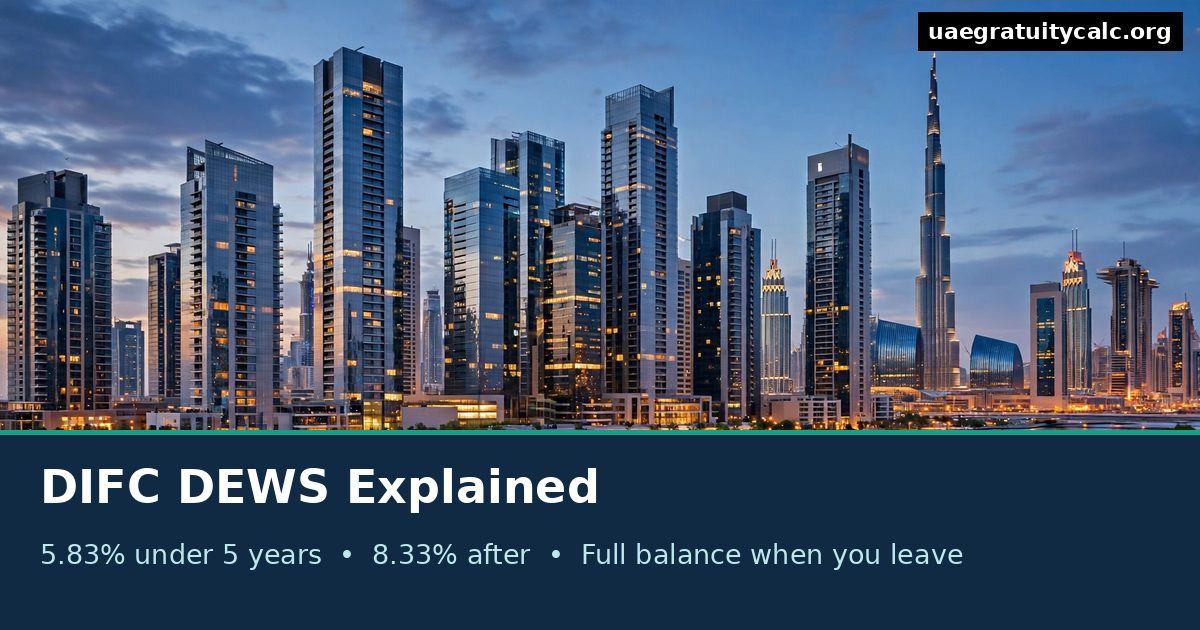
If you work in the Dubai International Financial Centre, the word 'gratuity' means something different. Since February 2020, DIFC employers do not accrue a lump sum payable on exit. Instead they pay monthly contributions into a funded, professionally managed savings plan — the DIFC Employee Workplace Savings (DEWS) plan — and the money is invested throughout your employment.
How DEWS works
The employer contributes a percentage of your monthly basic salary into the plan: 5.83% for the first five years of service, rising to 8.33% after five years. Those rates mirror the old 21-day and 30-day gratuity tiers, converted into a monthly payment. The money is held in trust and invested in funds you can choose from, so it can grow during your employment instead of sitting as an unfunded promise on your employer's books. You may also add voluntary contributions through salary deductions. Employer contributions vest after one year of service; your own voluntary contributions vest immediately.
What happens when you leave
On leaving DIFC employment you can withdraw your full balance. If you were employed in the DIFC before February 2020, any gratuity accrued before the switch remains payable in the old way — unless you agreed in writing to transfer it into DEWS. Transfers need your written consent; they are not automatic.
Who is not in DEWS
UAE and GCC nationals are generally outside DEWS because they accrue pension benefits through the GPSSA regime, although a top-up rule can apply for GCC nationals where the GPSSA contribution falls short of the DEWS minimum. Employers that run their own qualifying scheme instead of DEWS need a Certificate of Compliance from the DIFC Authority.
ADGM is different again
Abu Dhabi Global Market kept gratuity but rewrote it: under the ADGM Employment Regulations 2024 (in force 1 April 2025), gratuity is 21 days' basic wage per year for the first five years and 30 days after, pro-rated, with the daily rate calculated as annual basic wage ÷ 365, a floor of 50% of wages, and no two-year cap. DMCC, JAFZA and most other free zones follow the federal formula.
The federal voluntary savings scheme
Mainland and most free-zone employers may instead join the voluntary end-of-service savings scheme, where gratuity amounts are invested in approved funds rather than paid as a lump sum at exit. If your employer uses it, the federal calculator figure will not match your scheme balance — ask HR which system you are in before comparing numbers.
Three systems, three answers: federal gratuity, DIFC monthly savings, ADGM gratuity without a cap. The first question is always which regime your contract sits under — everything else follows from that.